
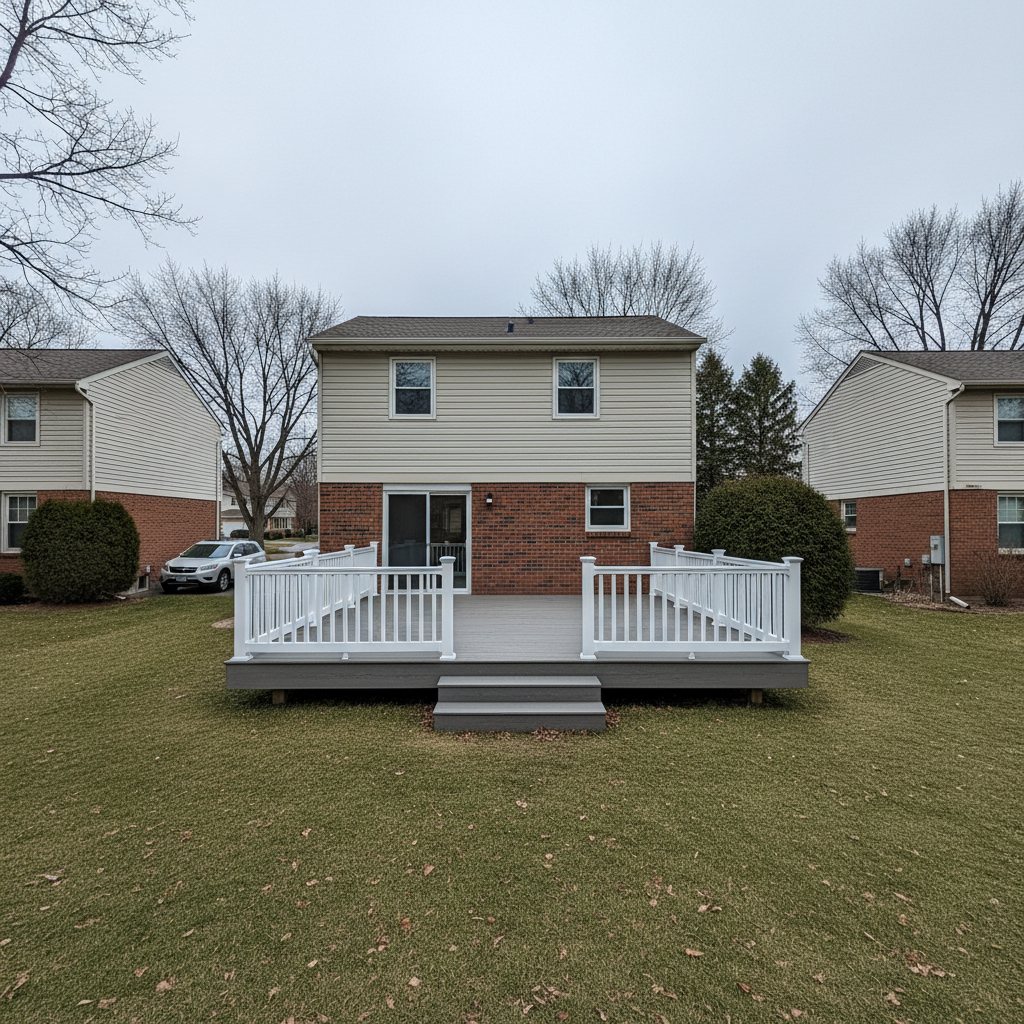
Anybody with a truck and a miter saw can call themselves a deck builder. The work that separates a deck that lasts twenty years from one that's wobbling by year five happens below the boards, where you'll never look once it's built. This is what to check before you sign anything.
Ask about footings before you ask about boards
In Dane County the frost line runs around 42 inches. That means any footing holding up your deck needs to go down past that depth, or the ground will heave it every winter when the soil freezes and pushes back up every spring when it thaws. A lot of the clay-heavy soil common on Sun Prairie lots makes this worse than sandy ground would, because clay holds water and expands more as it freezes. A builder who tells you an 18-inch tube footing will be fine, or who wants to just stack a deck on top of existing concrete pavers, is setting you up for a deck that leans within a few seasons.
Ask them straight: how deep are the footings, and are they using sonotubes poured to solid bearing, or something shallower to save a day of digging. A good builder will have an answer without hesitating, because they've had to explain it to inspectors plenty of times.
Permits aren't optional, and skipping one should worry you
The City of Sun Prairie requires a permit for most new deck construction, and for a lot of repair work that touches structure rather than just replacing boards. The inspector is checking footing depth, ledger attachment, joist spacing, and railing height, usually with at least two site visits, one before the decking goes down and one at final. If a builder offers to skip the permit to save time or money, that's not a favor. It means nobody independent is checking that the footings actually hit frost depth or that the ledger is lagged into the rim joist correctly. It also means if you sell the house later, an unpermitted deck can hold up the sale or force a retroactive inspection you don't control the timing of.
If your lot is in one of the newer subdivisions on the east or north side with an HOA, there's usually a separate approval step for anything visible from the street, deck height and setback included. Older neighborhoods closer to downtown generally don't have that layer, but older lots also tend to have older, smaller setbacks and sometimes a property line that isn't where you think it is. A builder who asks for your plat of survey before designing anything is doing it right.
The ledger board is where most failures start
If your deck attaches to the house, the ledger board is the single most important connection in the whole structure. It has to be lagged or bolted into the rim joist, not just nailed, and it needs flashing behind it so water running off the house doesn't get trapped between the ledger and the siding. That flashing detail is boring to talk about and it's the thing that rots a ledger from the inside over five or six years of Wisconsin snowmelt and spring rain sitting against the wood. Ask whether they're using self-adhering flashing tape and metal flashing, or just caulk. Caulk fails. Flashing doesn't, if it's installed right.
Joist hangers matter too. Code calls for specific hangers rated for the lumber size, fastened with the nails or screws the hanger manufacturer actually specifies, not whatever's in the nail gun that day. It's a small thing that's easy to shortcut and hard to notice until the deck starts to bounce.
Material choices and what they actually cost you later
Pressure-treated pine is still the most common frame material, and it's fine for framing as long as it's rated for ground contact where it touches footings or sits low to grade. For the decking surface itself, you're choosing between pressure-treated boards, cedar, and composite. Composite costs more up front, often 30 to 50 percent more than treated lumber, but it doesn't need staining every two to three years the way wood does, and it won't splinter or cup the way treated pine can after a few Wisconsin winters of freeze-thaw cycling. If your builder pushes one material hard without asking what you actually want to maintain, that's worth noticing. There's no single right answer, there's a right answer for how much upkeep you want to do.
Fasteners matter more than people think. Deck screws should be coated for exterior and treated-lumber contact, because the chemicals in modern pressure-treated wood corrode plain steel. A builder using whatever screws were cheapest at the box store is cutting a corner you'll see as rust streaks in two or three years.
What to walk away from
- A quote with no mention of footing depth, permit status, or ledger flashing. If none of that's in the proposal, it probably isn't in the plan either.
- Pressure to sign the same day, or a discount that only applies if you commit before they leave your driveway.
- No insurance certificate when asked. A builder working on your property without liability coverage makes any accident your problem.
- A builder who can't tell you roughly how many days the job will take. A standard single-level deck usually runs one to two weeks depending on size and weather; a multi-level deck or a screened addition takes longer. Vague answers here usually mean a vague schedule once they're on site.
- Nobody willing to give you a written structural spec, even a simple one, showing footing size, joist spacing, and beam sizing for your specific deck.
None of this is complicated once you know what questions to ask. Most builders who are doing the work correctly are glad to talk through footings and flashing in detail, because they've done it enough times that it's second nature. The ones who get vague or impatient when you ask are telling you something.
If you're planning a deck, repair, or inspection in Sun Prairie or the towns around it, you can see more of our deck builder work and get a straight answer about what your project actually needs.